Texans who respect and revere gun rights have seen this act before.
They rejected former U.S. Rep. Robert Francis “Beto” O’Rourke (D-Texas) at the ballot box in 2018 when he ran against U.S. Sen. Ted Cruz (R-Texas) on a platform that included strict gun control. National Democrat voters rejected him again in 2020 when he tried his hand at a White House bid. That campaign went so badly for him that he was forced to drop out before any primary election ballots were cast. Then he was crushed in the 2022 gubernatorial race against incumbent Republican Gov. Greg Abbott, with Texas voters again rejecting him by more than 10 points.
It turns out, yelling, “Hell yeah, we’re going to take your AR-15s,” from the debate stage isn’t a particularly effective way of winning over Texas voters.
Now, in 2026, Texas Democrats are once again running a candidate who proudly clutches onto the “ban Modern Sporting Rifles (MSRs)” gun control policy hoping, maybe this time, Texas gun owners will somehow vote differently.
Former Texas state Rep. James Talarico won the Democratic nomination for the U.S. Senate seat currently held by Sen. John Cornyn (R-Texas). Current Texas Attorney General (AG) Ken Paxton, an ardent Second Amendment supporter, is the Republican nominee.
It’s a stark contrast between the two candidates when it comes to Second Amendment issues that is a Texas country mile wide.
Breitbart News unearthed audio recordings of Talarico giving Texas state House floor speeches and podcast interviews in which he wholeheartedly voiced support for gun confiscation and registration schemes. That includes implementing bans on entire classes of common firearms, including MSRs — such as AR-15-style semiautomatic rifles. NSSF data show there are at least 32 million MSRs in private circulation, considerably more than there are Ford F-150 pickup trucks on the road. That will hit home in The Lone Star State.
Speaking with the South Asian American Voter Empowerment (SAAVE Texas) group, Talarico went all-in on gun control in true Beto O’Rourke fashion.
“I think universal background checks, I think closing the gun show loophole, assault weapon ban, large capacity magazine ban, I think restricting large firearm purchases, I think even we should start to think about handgun design safety standards as well,” former state Rep. Talarico said. “So probably in that order are the things I’m most interested in championing and working on.”
If that doesn’t scream at Texas voters, “Hell yeah, we’re going to take your guns,” I don’t know what does.
Shame’s the Game
If the flat-out strict gun control policies weren’t problematic enough for voters in a state like Texas, the Democrat nominee has also piled on with attempts to shame voters by using their religion.
Just three years ago, in a speech from the Texas state House floor, then-state Rep. Talarico invoked religion in an attempt to shame lawmakers into supporting stricter gun control after a deranged individual broke existing laws to commit a heinous crime.
“We prayed and God sent our colleague from Uvalde to bring a bill that would prevent tragedies from happening in the future,” then-state Rep. Talarico declared. “Instead of hearing that bill… we have ignored God’s messengers. This is moral madness.”
The madness belongs to Talarico, who claims God is nonbinary and can’t seem to remember that rights protected by the U.S. Constitution are granted by “our Creator,” as expressed in the Declaration of Independence. That recognizes an authority much higher than the one to which Talarico hopes to be elected.
The bill he was referencing would bar law-abiding American adults aged 18–20 from owning certain types of firearms. No other constitutional right imposes an age limit on adults over 18.
Misleading Voters
Talarico’s misguided Second Amendment policies come from his misunderstanding of the Second Amendment itself. During a 2020 video town hall, Rep. Talarico voiced his full-throated support for strict gun control, based on his faulty understanding of the Constitution.
“A lot of politicians like to talk about the Second Amendment,” Rep. Talarico asserted to the audience at a video townhall event. “Very few have actually read the Second Amendment because, if they did, they would know that the words ‘well regulated’ are right there in the text of the amendment itself.”
Rep. Talarico’s suggestion that “well regulated” meant that the Founders believed all along that gun rights were supposed to be heavily restricted or conditioned is as laughable as it should be disqualifying. We have a summer reading list for Rep. Talarico, and it begins with the U.S. Supreme Court’s decision in Heller.
In fact, Jonathan Turley, the Shapiro Professor of Public Interest Law at George Washington University, recently dismantled Rep. Talarico’s arguments.
“Militias were considered the backbone of the American military, particularly by those who feared a standing army,” Turley recently wrote in a Fox News column. “Some militias were less capable than others during the Revolutionary War. A well-regulated militia meant state militias that were combat-ready.”
#GUNVOTE This November
The November election is less than two months away. NSSF’s #GUNVOTE initiative was created to ensure all law-abiding American gun owners are registered to vote, know when and where to cast their ballot, learn where candidates stand on the Second Amendment and to make their voices heard on Election Day. That includes Texas voters.
As Rep. Talarico continues to try to sell his antigun platform to Texas voters, more of them will learn just how extreme that platform is and will reject it. NSSF will be there to help spread the word.
Most Americans are not getting outside enough to experience the benefits nature provides to their physical a mental health, according to a new national survey.
Jay Maddock, a Regents Professor at Texas A&M University’s School of Public Health, said even brief exposure to nature — 10 minutes a day — can make a big difference.
“Nature really is all around us,” Maddock said. “It can reset our attention, improve our mood and even affect our immune functioning.”
Maddock, who serves as director of the Center for Health and Nature at Texas A&M, was part of the team behind the American Nature and Health Survey, which received responses from more than 3,000 Americans.
“Compared to 2016, our time in nature has really declined steadily,” Maddock said. “One of the reasons might be that we have so many conveniences that we didn’t have before. Things like delivery services, where you can get your groceries, your Amazon packages, your food delivered right to your door, keep us inside more and more often. Screen time, in its variety of forms, has increased dramatically in the last decade, and that’s been offset by less time outside.”
The survey, launched by REI Co-op and the Nature and Health Alliance (NHA) and supported through the REI Cooperative Action Fund, also highlighted a significant opportunity for healthcare providers: while only 20% of people had ever been told by a doctor to spend more time in nature, 83% said they would spend more time outside if their doctor recommended it.
The survey will track how people experience nature over time, creating a credible, data-driven foundation for understanding trends, barriers and opportunities to expand Americans’ access to and connection with the outdoors. The benchmark is expected to be updated every two years, creating a long-term measure of how Americans’ relationship with nature evolves over time.
Maddock equates spending time in nature with practices that are universally accepted as essential: eating right, exercising and getting enough sleep. He believes more doctors need to prescribe nature to encourage their patients to get outside.
“We asked about if people’s doctor ever recommended that they spend time in nature,” he said. “Only 20% of people had their doctor tell them that, but 83% said that if their doctor did recommend more time in nature, they would spend more time in nature.”
Key findings from the survey include:
84% of Americans say protecting nature is essential or very important.
79% agree that wild, open and natural spaces are part of being American.
Nearly 45% spent less than two hours in nature during the previous week.
83% would increase time outdoors if recommended by a healthcare provider.
Maddock said the long-term survey will create “a shared foundation for researchers, healthcare leaders, community organizations and policymakers to better understand trends, barriers and opportunities over time.”
The survey follows last month’s release of “The Nature Dose,” an 11-minute documentary sponsored by outdoor gear giant REI that focuses on the health benefits of being outside.
It’s one of three short films created through a collaboration between The Redford Center, a nonprofit founded in 2005 by the late actor Robert Redford and his son to create environment-related films, and REI’s nonprofit Cooperative Action Fund, which supports projects related to making the outdoors more accessible.
“Over the past 20 years, we have become an indoor species, but spending time in nature is an easy way to improve our health,” Maddock said. “Sitting in a greenspace outside for just 10 minutes—the nature dose in the film’s name—has been found to reduce stress, lower blood pressure and strengthen our immune systems, and we can even bring health benefits indoors by adding houseplants.”
“The Nature Dose” was directed by Andrew Nadkarni and also highlights the work of Nalini Nadkarni, an expert on trees and their importance, and Jennifer Roberts, an expert on how environmental inequities affect physical health.
Modern politics has a gift for parodying itself, but even by Colorado standards, this one is hard to improve upon: the campaign warning voters against a constitutional right to hunt and fish has found itself with a hunter delivering the message. Enter Eric Washburn, president of the newly formed Colorado Hunters and Anglers for Sensible Wildlife Conservation, who has come forward to explain why hunters should be alarmed by the prospect of protecting hunting.
Washburn says he hunts big game, holds multiple Colorado licenses, and has hunted waterfowl. Fine. Nobody needs to inspect his freezer. The interesting question isn't whether Eric Washburn hunts; it's how a professional public-affairs consultant with a long record of advocating wildlife policies frequently at odds with traditional sporting constituencies became the man being presented as the voice of Colorado hunters. Calling him representative of the wider sporting community is a little like sending the tofu burger to address the National Cattlemen's Beef Association: technically everyone is discussing dinner, but somebody may have wandered into the wrong banquet hall.
And therein lies the comedy. Washburn's pitch is that constitutional protection for hunting could endanger hunting. In other words: fellow sportsmen, we must act now to protect hunting from the grave threat of being protected. Political satire usually has to exaggerate. This time it can simply take notes.
Washburn's organization argues that the amendment could trigger litigation over existing hunting regulations, weaken public support for the sport and interfere with flexible wildlife management. There is certainly an argument to be made there, and people are free to make it. But the political theater is impossible to miss. Nothing says authentic representative of the sporting community quite like showing up to oppose constitutional protection for the activity that supposedly qualifies you to represent the sporting community in the first place.
The story gets more interesting when one looks beyond the camouflage. Washburn is a senior adviser to Pioneer Public Affairs, which describes him as a consultant who for the past 16 years has worked for private, nonprofit and philanthropic clients on energy and natural-resource issues. Before consulting, he worked in senior policy positions for Democratic Senate leaders Tom Daschle and Harry Reid. He also helped found the Theodore Roosevelt Conservation Partnership, giving him genuine conservation credentials as well as a long résumé in professional public policy and advocacy.
None of that proves anything sinister, nor should it. Consultants are allowed to consult, and people who work in public affairs are allowed to hold opinions. But when an advocacy effort presents someone chiefly as a concerned hunter stepping out of elk camp to save wildlife management from dangerous constitutional meddling, it is reasonable to mention that his day job is, well, professional public affairs. That is not an accusation. It is context, and context has a funny way of making political branding look considerably less organic.
That distinction matters because Washburn's published writings reveal a wildlife philosophy considerably more complicated than the generic image of the average Colorado deer or elk hunter.
In 2023, he defended Gov. Jared Polis' appointments to the Colorado Parks and Wildlife Commission against criticism from sportsmen, arguing that the traditional commission model was too narrowly focused and writing approvingly of commissioners bringing broader perspectives to wildlife policy amid concerns about climate change, habitat loss, and species extinction. That same year, he praised the creation of the Colorado Nature League and advocated greater attention and funding for nongame, threatened and endangered species. His writing also questioned Colorado's treatment of species such as beavers and argued for a wider conception of wildlife management.
And then there are wolves. Washburn was an outspoken supporter of wolf restoration after Colorado voters approved reintroduction, and his previous writings urged the state to move forward while criticizing what he regarded as excessive alarm from opponents. Again, none of this disqualifies him from hunting. It does, however, make the image of Washburn as the spontaneously materialized Voice of Colorado Sportsmen considerably more amusing.
Perhaps somewhere in the Routt National Forest there is an enormous constituency of elk hunters who spend evenings around the campfire complaining that wildlife commissions have focused too much on game species, wondering whether wolves can be restored faster and talking about how best to increase funding for nongame programs. Perhaps they are out there in great numbers, silently cleaning rifles while debating beaver-management philosophy. Perhaps they simply keep very quiet.
Washburn's organization also includes figures with histories that depart from what many sportsmen would regard as conventional hunting advocacy. Colorado Politics has reported that member Gary Skiba had previously been associated with Defenders of Wildlife and was described by that organization as the primary author of Colorado's wolf conservation plan. Skiba's appointment to represent sportspersons on the Colorado Parks and Wildlife Commission ran into opposition in the Colorado Senate and was ultimately withdrawn. That doesn't make these people secretly anti-hunting. It does make the branding somewhat spectacular.
The organization might more precisely have been named Colorado Hunters Who Agree With Many Organizations That Frequently Disagree With Colorado Hunters, although admittedly the logo would require a much larger trucker hat.
Then there is Wildlife for All, which has simultaneously urged journalists to investigate the political machinery behind the right-to-hunt amendment. Its public materials have encouraged scrutiny of the amendment's architects, their motivations, and the larger national movement supporting constitutional hunting protections. Excellent. Journalists should investigate political campaigns. All of them.
If funding and affiliations matter when examining the amendment's supporters, they matter just as much when reviewing its opponents. Who funds newly created opposition organizations? Who provides their communications strategy? What professional relationships exist among the people speaking publicly? Who recruited whom? Are consultants volunteering, billing clients, or simply participating as private citizens?
Those are not accusations. They are the sorts of questions reporters routinely ask when political advocacy arrives wearing the costume of spontaneous grassroots concern. Questions about Washburn’s professional background makes inquiries about funding, affiliations, and disclosure perfectly legitimate. An opposition movement that demands intense scrutiny of its adversaries can hardly clutch its pearls when somebody turns the flashlight around. Transparency, like science-based wildlife management, presumably works in both directions.
Meanwhile, the amendment itself is not quite the lawless wildlife-management apocalypse sometimes conjured by its critics. Colorado's legislative analysis identifies the proposal as a constitutional right to hunt and fish, and its language preserves governmental authority to regulate wildlife when necessary for scientific conservation and management, public safety, or preservation of future hunting and fishing opportunities.
Legitimate legal questions surround terms such as “customary methods,” and detractors claim those words could invite litigation over existing restrictions. That debate belongs in the public square. What is harder to take seriously without at least a raised eyebrow is the suggestion that constitutional recognition of hunting somehow becomes self-evidently dangerous to hunters.
Which brings us back to Washburn and the strange little masterpiece of political branding surrounding him. Colorado is being asked to regard a professional natural-resources consultant, wolf-restoration advocate, and longtime champion of a wider reordering of traditional wildlife management as an especially authoritative spokesman for hunters concerned that hunting might become too constitutionally protected.
Maybe Washburn loves hunting. I have no reason to doubt that he does. But owning camouflage, drawing tags and occasionally carrying a rifle into the mountains no more makes someone representative of Colorado sportsmen than owning a pickup makes someone president of the ranchers' association. The relevant question was never whether Washburn qualifies as a hunter. It is whether his political philosophy, work relationships, and public record qualify him to be marketed as the authentic voice of a sporting community whose traditional priorities he has repeatedly challenged.
That distinction matters, particularly when advocacy organizations are so keen to put “hunter” in large type while leaving the rest of the résumé in considerably smaller print. So by all means, let Eric Washburn speak. Let Wildlife for All speak. Let every organization on every side make its case, disclose its interests and explain who is paying the bills. But spare Colorado sportsmen the theatrical suggestion that opposing constitutional protection for hunting somehow becomes an expression of mainstream hunting culture simply because the person holding the microphone owns a hunting license.
Eric Washburn may be a hunter. But being the voice of Colorado hunters is another matter entirely.
One requires a tag. The other requires a constituency.
– Chris Dorsey
Chris Dorsey is a Coloradan, 30-year media veteran, biologist, outdoor television producer and natural history filmmaker whose writing has appeared in the Wall Street Journal, Newsweek, Forbes and dozens more national titles.
Sturgeon Palooza will commemorate a quarter century of research, restoration and partnerships that have helped revive Michigan's iconic lake sturgeon population.
The impact MSU has had when it comes to sturgeon can be observed many ways, said Scott Colborne, an MSU Department of Fisheries and Wildlife assistant professor who took over MSU’s sturgeon research program in 2024 for Kim Scribner, a professor emeritus in the same department.
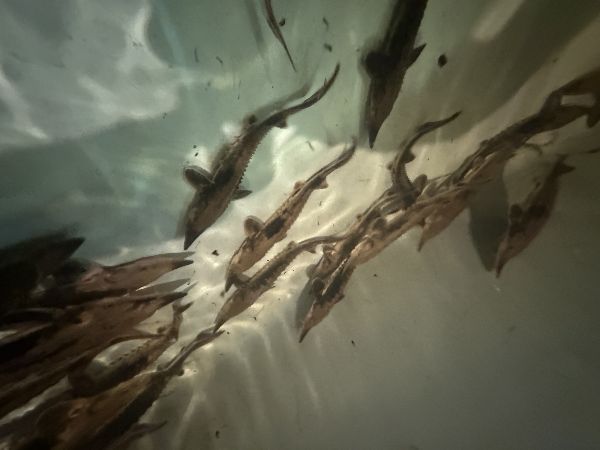
Juvenile lake sturgeon swim in their holding tank at the Black River Sturgeon Rearing Facility run by Michigan Department of Natural Resources and Michigan State University. At the time of this picture these fish were about to be released into Black River during August 2025. (Photo Credit: Scott Colborne)
“Twenty-five years of research has taught us an incredible amount about lake sturgeon and what it takes to restore these populations,” Colborne said. “We can see that in the recovery of the Black Lake population, in young sturgeon once again showing up in places like Saginaw Bay, and in more than 80 scientific publications that have expanded our understanding of these fish. But one of the most exciting things about a program like this is that the value of the work continues to grow. We now have decades of data, new tools and experience that allow us to ask questions that simply weren’t possible when the program started.
“The impact also extends well beyond the science and the fish. Eighteen graduate students and more than 100 undergraduate research technicians from across the country have been part of this program, and we’ve seen how these fish can capture the imagination of communities and spark curiosity in the next generation. While Sturgeon Palooza is celebrating what this program has accomplished over the last 25 years, we are very excited about where it can go over the next 25 — and how our research, partnerships, and education efforts can continue to have an impact for sturgeon and the Great Lakes more broadly.”
While this celebration will mark all the accomplishments made by MSU and its partners in revitalizing sturgeon in Michigan’s water systems, restoring critical ecosystem functions and engaging local communities, this work is far from over, echoed Doug Larson, an MSU research assistant who helps run the Black Lake Stream Side Rearing Facility.
“When you look back over the last 25 years, it's remarkable how much has changed,” Larson said. “We started by answering very basic questions about how to restore these populations to having decades of information on individual fish in this population. But for a species which lives hundreds of years, we've only scratched the surface. The long-term datasets and partnerships we've built give us opportunities to ask questions today that we couldn't have imagined when this started.”
MSU helping uncover and share the lessons taught by these ‘durable’ fish
Often referred to as “dinosaur fish” for having been around when dinosaurs roamed the planet more than 100 million years ago, lake sturgeon are the Great Lakes’ oldest fish species, according to Sturgeon for Tomorrow, and one of the largest, with torpedo-shaped bodies that can weigh hundreds of pounds and span over 7 feet.
Unfortunately, their size alone couldn’t protect them from the overharvesting, habitat loss and pollution they experienced in the Great Lakes basin throughout much of the 19th and 20th centuries, and since the late 1980s, they’ve been listed as “threatened” or “endangered” in 19 of 20 states in the Mississippi River, Hudson Bay and Great Lakes basins.
The work MSU and partner organizations have been doing over the last quarter century to tag, track and understand the species better to promote their conservation and restoration is changing that narrative, said Jay Woiderski, president of Sturgeon for Tomorrow.
“Many things that MSU and partners have done through the years have helped to understand how big the sturgeon need to get to be released so that they have a chance at making it into the wild,” Woiderski said. “The difference in survival rate between a newly born sturgeon and one that has reached a 5- to 6-inch length after a few months of being cared for in the hatchery is well under 1% to over 70%. That took years to figure out where that point was.”
Research done at Black Lake by MSU and the Michigan Department of Natural Resources (DNR) has also helped to provide insights about the sturgeon living in Michigan’s water systems long before this work began. Black Lake is locked in by dams in the upstream and downstream parts of the Black River watershed surrounding the lake, and because of this, sturgeon living in this region can be easily monitored and studied over long periods of time.
Earlier this year, a team including Colborne, Larson, Scribner and Ed Baker, research station manager of the Michigan DNR’s Marquette Fisheries Research Station, published a paper detailing how sturgeon — which were previously thought to live around 80-100 years — could live up to 200, 300 or even 400 years.
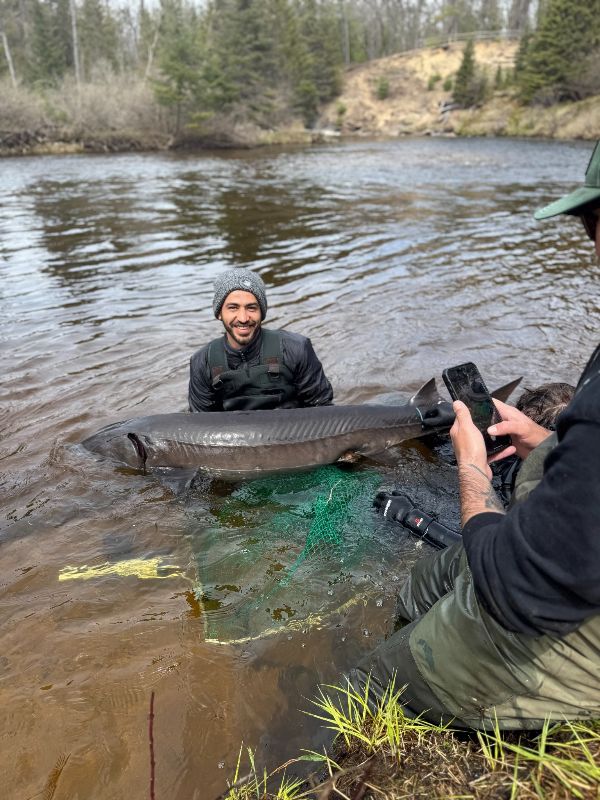
MSU doctoral student Mohamed Khalifa holds an adult lake sturgeon in the upper Black River collected during the spawning run in spring 2026. (Photo Credit: Scott Colborne)
A finding like this that provides deeper clarity into sturgeon biology, Baker said, contributes to a greater understanding of how the Michigan DNR and others can shape conservation strategies and management decisions, which for the past 25 years, have helped to successfully bring back parts of the sturgeon population in Michigan.
“The partnership we have with MSU at our Black Lake research site and hatchery has been an incredibly productive relationship over the past 25 years,” Baker said. “When we started our work there, we didn’t know much about basic lake sturgeon biology, and over the past 25 years, the research we’ve done there has really expanded our understanding of that and has informed our management actions as an agency in trying to restore sturgeon, which we’re starting to see.
“The population in Black Lake, where we do our research, is on the rebound. The adult abundance is continuing to increase.”
Baker said fish from the Black Lake hatchery are now being used to stock other bodies of water within the same watershed as Black Lake, as well as other water systems such as the Saginaw River and other hatcheries such as one managed by the Grand Traverse Band of Ottawa and Chippewa Indians along Boardman River in Traverse City.
The importance of sturgeon can’t be understated.
As a bottom feeder, sturgeon play a profound ecological role in moving nutrients from lakes into rivers when they spawn. Their longstanding ancestry and history hold sacred meaning within many tribal nations.
They’ve previously been an economically significant species for Michigan’s recreational fishing economy. Today, however, stringent management regulations limit when anglers can catch sturgeon. Spearing season at Black Lake lasted only 17 minutes in 2025. Baker said he hopes that with continued success in restoring them, sturgeon can once again become an integral part of Michigan’s fishing experience in the future.
But for Mike Kelly, Great Lakes director of The Conservation Fund, one of the aspects he values most about sturgeon and the role MSU has played in restoring them is how they bring people together.
“Obviously, bringing back the fish population is the overarching goal, but the unique thing about sturgeon is despite the fact they’ve been around for 130 million years, and despite the fact they’re a threatened species, these little fish that come from the MSU hatchery at Black River are durable fish,” Kelly said. “They lend themselves very well to these public restoration events we hold in cooperation with MSU and a bunch of other partners, where we can bring people down to the river — kids and adults alike — and give them the opportunity to hold one of these fish and release them into one of the four waterways: the Cass River, Flint River, Tittabawassee River and Shiawassee River.
“From my perspective, as I mentioned, obviously bringing back the species is the No. 1 priority, but right behind that is the opportunity to bring people down to the river to help them understand why our rivers are so important, and let them play the role of a citizen scientist as part of this project in helping to release and restore this population.”
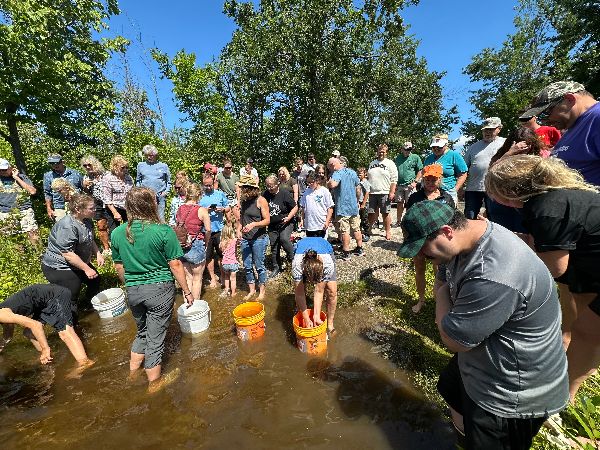
The community release event for lake sturgeon in the upper Black River held during August 2025. As part of the annual release program, community members are invited to help release sturgeon into the wild at multiple locations across Michigan. (Photo Credit: Scott Colborne)
The effort to restore sturgeon is an all-hands-on-deck approach. From researchers diving into Black Lake to study them to students raising them in the classroom through Sturgeon in the Classroom and volunteers keeping watch over Black River to protect them from poaching, everyone is involved.
Kelly said of all the projects he’s been involved in, restoring sturgeon has been the greatest example to him of the power of partnerships, noting MSU’s critical role in helping run the Black Lake Stream Side Rearing Facility and educate people through MSU Extension. Continued funding for this work, he said, is essential.
“One of the things also to remember about this population is that unlike a lot of other fish species, these fish are long-lived,” Kelly said. “They don't reach maturity for 15 or 20 years. The fish that we're putting in the rivers right now don't come back to spawn for a couple decades from now, and they don't spawn every year.
“If there’s one project that needs to be looked at as a long-term project, it’s this, and I think funding needs to support that. People need to understand that we damaged this population, and it’s up to us to bring it back. It’s also important, along with sturgeon, to remember how fragile our ecosystem is sometimes. It doesn’t take long to do serious damage to it.”
Sturgeon teaching MSU students how to become scientists and stewards
Not all the research being done on sturgeon involves getting in the water with them. For Delsin Wright, an MSU Fisheries and Wildlife undergraduate who’ll graduate this fall, some of it has meant spending days in Microsoft applications organizing and analyzing complex datasets detailing the records kept on sturgeon over the past 25 years.
His connection to sturgeon started in 2023 when he interned with the Michigan DNR, working with the Gun Lake Tribe to restore sturgeon in West Michigan. In 2024, he transferred to MSU and connected with Colborne, Larson and others in the MSU AgBioResearch-supported Quantitative Fisheries Center, assisting them with their research.
After reworking their dataset to make it more user-friendly, he was offered a field position in 2025 where he could interact directly with the sturgeon at the Black Lake facility.
“It was cool how things played out,” Wright said. “I had a lot of fun with the database work and working out in the field. It was my first real experience with both research and hands-on fieldwork, and from those experiences, I fell in love with it. I realized this is really where I want my career to go.”
Some of Wright’s greatest memories working on-site at Black Lake were hiking along the spawning grounds with dive and shore teams. Dive teams would fish sturgeon — or sometimes wrestle ones weighing 100 pounds or more — out of the water and pass them to shore teams who’d collect measurements and samples.
Being in the presence of these gigantic and historic fish, as well as learning more about them and the significance they’ve had within communities across the state for hundreds of years, has shaped how Wright views the responsibility there is to safeguard them.
“Learning more about the history involved has been a really fun part because it’s a much deeper story,” Wright said. “It’s not just that these are cool fish. They’ve got a history that goes back hundreds of years. Going back to the life cycle of these fish, it’s possible that some were babies when tribes were the only ones inhabiting these lands.
“For me, these fish put a lot of things into perspective. They give me a lot to think about beyond the traditional conservation mindset we apply. It’s a broader picture, which I really appreciate. It’s good to not only know about these things but also respect and be a part of them as much as you can.”
Working at the Black Lake facility as a summer technician and being able to participate in various research projects also sparked a love of fisheries research for Jake Kimmel, so much that he applied for and accepted a role as an MSU graduate research student there in 2019 after completing his undergraduate degree.
His graduate research project, which focused on lake sturgeon behavior and sense of smell, was co-advised by Kim Scribner and Weiming Li, a professor and Frederick E.J. Fry Chair for Environmental Physiology in the MSU Department of Fisheries and Wildlife. After three more years at the facility completing his graduate research, Kimmel accepted a position in Li’s lab post-graduate school studying invasive sea lamprey.
Kimmel has since gone on to work at the Great Lakes Fishery Commission to continue researching sea lamprey, but he said the knowledge gained by working with sturgeon at the Black Lake facility has been indispensable to his career.
“Because of my interest and willingness to get involved and ask questions, the researchers at Black Lake were willing to give me opportunities,” Kimmel said. “They gave students ideas about things that needed to be solved and let us run with them and try to figure them out ourselves. That helped my career, gave me a lot of skills in research and problem-solving, and grew my independence and confidence. It was an invaluable experience.”
*This story is part of a series highlighting the impact of MSU AgBioResearch’s work with Michigan agriculture and natural resources that includes our stakeholders' perspectives. Through partnerships with the State of Michigan and industries, MSU AgBioResearch is finding solutions to some of the most timely problems facing our state. To view the entire series, visit agbioresearch.msu.edu.