SUBSCRIBE    ARCHIVES SATURDAY, OCTOBER 3, 2026

- EDITOR'S NOTE -

This was supposed to hit your inboxes yesterday morning. Unfortunately, as you have already noticed, that did not happen. Hopefully you'll be able to find time between Sunday church services and a full slate of NFL games to peruse this week's Weekend Edition.


Somebody ought to manufacture fishing waders specifically for sitting on the fence. Reinforced seat. Extra padding. Absolutely no traction. Send the first pair to Trout Unlimited, which seems to need considerably more preparation to defend the right to fish than most of us need to go fishing.

Ducks Unlimited, Rocky Mountain Elk Foundation, Safari Club International, Mule Deer Foundation, Backcountry Hunters and Anglers, Congressional Sportsmen’s Foundation, Coloradans for Responsible Wildlife Management and virtually every other hunter or angler supported group has enthusiastically endorsed Amendment 83.

TU is missing from the campaign’s published coalition, and at this writing I could find no public endorsement from either national TU or Colorado TU. An organization so closely associated with fishing ought not require a search party to locate its position on protecting the right to fish.
 
A memo supplied to me as an internal TU analysis helps explain the hand-wringing. Undefined language could invite litigation, they fear. Existing restrictions could encounter difficulties. Lawyers could become involved. Well, there goes the republic. Had this standard prevailed in Philadelphia, the Bill of Rights would still be awaiting clearance from the Subcommittee on Things That Might Upset Somebody. Rights matter precisely because government must answer for restricting them. The possibility of having to defend one is an unusual reason not to establish it.

Read subsection four. Amendment 83 preserves state regulatory authority when a law is necessary for scientific wildlife conservation and management, public safety, or preserving future hunting and fishing opportunities. Those are alternative grounds for regulation. It does not hand every license buyer a constitutional permission slip to dynamite a trout stream. The conservation safeguards are right there, inconveniently interrupting the panic.
 
Yes, “classic methods” leaves room for interpretation. Neither the statutory spring bear restrictions nor the constitutional restrictions on specified traps is expressly repealed, and nobody can promise what future courts would decide. But an existing regulation does not become holy writ merely by surviving several generations of fishing catalogs. If a restriction cannot withstand the amendment’s conservation and safety standards, why should a science-minded organization consider its reconsideration an outrage?
 
The memo’s warning about lawyers and courts displacing scientists is especially rich given Colorado TU’s own experience. In April, TU reported that the wildlife commission advanced a fur-ban petition over agency staff objections. TU called the proposal “an anti-hunting, angling and trapping position without any basis in science and sound wildlife management.” Its words. The scientists had already been overruled. Apparently, they were supposed to find comfort in knowing no constitutional right had complicated the proceedings.
 
Nor does TU require smelling salts whenever somebody refers to a courthouse. In July, it described its participation in litigation defending Bristol Bay’s Clean Water Act protections. Good. That is a fight worth having. But the memo’s anxiety about litigation sits awkwardly beside the organization’s willingness to litigate for habitat. Lawyers do not become a conservation hazard simply because the people holding fishing rods might benefit from their work. 

TU also praised expanded federal hunting and fishing access in January. That deserves acknowledgment, not erasure. It makes the missing endorsement harder to understand. An organization willing to celebrate additional places to fish should be able to explain why stronger protection for fishing itself apparently requires another lap around the conference table.
 
Perhaps some anglers imagine they enjoy diplomatic immunity because they release their trout and dress like assistant professors on sabbatical. PETA calls catch-and-release fishing “cruelty disguised as sport.” Your barbless hook is not a peace treaty. Neither is the photograph of you holding a rainbow as though you just delivered it. To opponents who reject recreational fishing, the problem is not your technique. It is what you came to the river to do. 

This argument has already made its way into the fundraising brochure. Parts of Europe already prohibit angling with the intention of releasing the catch. That is, animal activists in Europe have succeeded to convincing much of the population that putting a hook through a fish’s jaw for the angler’s enjoyment constitutes cruel behavior. Perhaps a hookless fly is next?  That is not a blanket fishing ban but it restricts the deliberate catch-and-release approach familiar to American anglers. The distinction should concern TU, not reassure it.
 
What happens when a future Colorado proposition promises to stop the “torture” of trout by banning recreational hooking? Does TU explain that the fly was hand-tied? Seek an exemption for donors whose rods cost more than their first cars? Produce a moving film about all the streamside willows its volunteers planted? None of those answers addresses the accusation. A campaign against fishing will not award extra credit for tasteful fleece.

TU’s members deserve leadership before that fight arrives. They should not have to choose between restoring a river and defending their ability to fish it. Support Amendment 83, explain the genuine legal questions, and help answer them. That would be conservation leadership. Sitting out while other sportsmen carry the argument is something else.

Healthy trout have backbones. On Amendment 83, their most famous advocates ought to find theirs.

– Chris Dorsey

Chris Dorsey is a Coloradan, 30-year media veteran, biologist, outdoor television producer and natural history filmmaker whose writing has appeared in the Wall Street Journal, Newsweek, Forbes and dozens more national titles. 

California Democrat Gov. Gavin Newsom signed 10 more gun control bills into law recently, expanding restrictions on firearm purchases, manufacturing technology and who qualifies as a prohibited person. The package adds new requirements for lawful gun owners and firearm industry businesses while making some changes to existing criminal enforcement and violence prevention programs.

California already requires universal background checks, generally imposes a mandatory 10-day waiting period on firearm purchases and maintains extensive restrictions on prohibited possessors. It’s not that California doesn’t have layers of redundant gun control laws that don’t actually address criminals but trample on Second Amendment rights. California is where gun control continues to generate constitutional litigation. The moves are less surprising, though, given Gov. Newsom’s 2028 presidential ambitions.

Another Requirement for Lawful Purchasers

Senate Bill 948 adds a new training requirement to California’s existing firearm ownership training certificate process. Beginning Jan. 1, 2029, affected applicants must complete at least four hours of qualifying instruction within the preceding year, including live-fire exercises at a shooting range. Some exemptions are in place.

California already requires most prospective purchasers to obtain a “firearm safety certificate,” pass a written examination and demonstrate safe firearm handling. Background checks and a waiting period impose further requirements before a lawful transfer can occur.

SB 948 introduces even more layers and Second Amendment roadblocks involving course availability, higher instructional costs, transportation considerations and access to shooting facilities. For prospective purchasers, those costs come even before taking home a lawfully purchased firearm. For instructors and ranges, the requirement creates additional demand for qualifying training.

Whether these new mandates will provide any measurable benefits beyond the existing certification system remains to be seen. There is a distinction between increasing restrictions and requirements for lawful firearm purchasers and addressing how criminals acquire firearms, almost always illegally.

A Bureau of Justice Statistics Survey of Prison Inmates found that 90 percent of state and federal prisoners who possessed firearms during their offenses obtained them somewhere other than a firearm retailer, illustrating why policies operating exclusively through lawful retail transactions almost never directly addresses the actual source of criminal firearms. A Californian buying a gun from a firearm retailer must navigate California’s acquisition requirements. Criminals don’t bother, illegally obtaining a firearm through theft or the black market.

SB 948 also expands requirements affecting people moving into California with firearms. Beginning Jan. 1, 2028, affected personal firearm importers must certify that they hold a valid firearm safety certificate or qualify for an exemption. The measure extends the firearm reporting period from 60 to 180 days. These new rules are ripe for turning otherwise lawful gun owners into criminals without even knowing it.

More Requirements, Different Approaches

Assembly Bill 2047, the Firearm Printing Prevention Act, establishes a process for requiring certain three-dimensional printers sold in California to incorporate technology intended to block firearm and machinegun conversion device (MCD) designs. Implementation depends on the development of qualifying technical standards and subsequent state action. The legislation also raises First Amendment questions concerning digital code and the regulation of multipurpose technology; an uncertainty acknowledged in the California Senate Judiciary Committee’s own analysis.

Assembly Bill 1943 addresses school notifications about secure firearm storage, while Assembly Bill 1974 authorizes law enforcement agencies to establish voluntary temporary firearm storage programs. Storage education and voluntary safekeeping are distinct from restrictions imposed on lawful firearm acquisition. The Sage Journal recently published a study showing that state-level gun storage laws don’t change gun owners’ behavior when it comes to firearm storage habits in the home.

Their effectiveness should likewise be evaluated against their respective objectives rather than treating all 10 bills as interchangeable.

Other legislation in the package addresses prohibited persons and enforcement procedures. Senate Bill 1220 establishes a 10-year firearm prohibition for individuals convicted of specified offenses involving firearms with illegally altered or removed identifying marks. And Assembly Bill 1743 expands access to crime firearm tracing information, further risking the opportunity for antigun state officials from using the sensitive data for “name-and-shame” schemes to penalize lawful firearm retailers that have committed no crime. Assembly Bill 2378 establishes a taxpayer-funded Office of Community Violence Intervention, forcing law-abiding Californians to foot the bill for the criminal actions of those who break the law and cause harm.

The constitutional distinctions are equally important and several of the state’s existing firearm restrictions remain subject to federal litigation. In July, the U.S. Department of Justice (DOJ) challenged California’s handgun roster and restrictions on certain commonly owned semiautomatic pistols, alleging Second Amendment violations. That constitutional challenge remains pending.

California Policy, National Implications

Gov. Newsom boasts that he leads the state with the “strongest gun laws in the country” and that “his gun laws work.” But he ignores that crime is trending down across the nation and gun owners continue to grow, even in California.

California’s latest package also arrives as Gov. Newsom’s national political activity attracts attention ahead of the 2028 presidential election. He hasn’t announced yet and said he would not seek the Democrat nomination if former Vice President Kamala Harris enters the race. However, 61 percent of Democrats polled recently said they would be excited if he decided to run, while the majority — 55 percent — would not be excited if former Vice President Harris decided to run.

His firearm policy proposals, however, predate the current presidential discussion. In 2023, Gov. Newsom proposed a 28th Amendment to the U.S. Constitution that would establish a nationwide minimum firearm purchasing age of 21, universal background checks, a waiting period for firearm purchases and ban on Modern Sporting Rifles (MSRs). That failed so badly and quickly he had to walk it back and now hopes voters forget.

But the firearm industry doesn’t forget. Voters won’t either.

– Larry Keane

Larry Keane is SVP for Government and Public Affairs, Assistant Secretary and General Counsel of the National Shooting Sports Foundation.

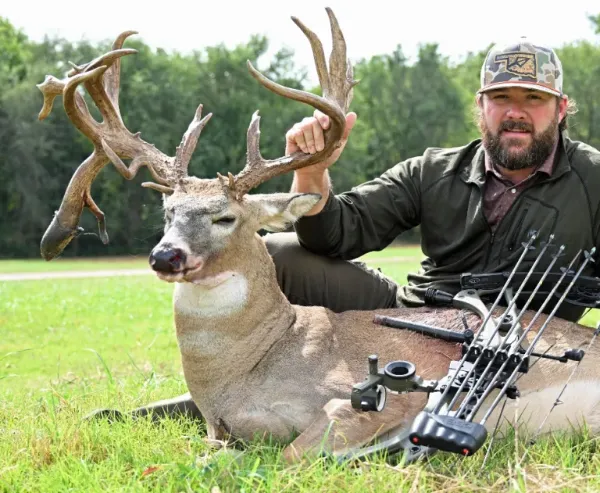
Kreg Griffith harvested this nontypical white-tailed deer scoring 201 3/8 in October 2025. Photo courtesy ODWC

To safeguard Oklahoma’s wildlife and prevent unregulated commercial release of white-tailed deer into the wild, the Oklahoma Department of Wildlife Conservation (ODWC) has proposed rules for the Chronic Wasting Disease (CWD) Genetic Improvement Act.  

Hunting white-tailed deer in Oklahoma is a deeply cherished tradition, backed by an avid hunting base. Thanks to years of intentional herd management by ODWC and increasingly selective hunters, Oklahoma’s wild deer population is thriving with a notable rise in mature, older-age-class bucks.  

Oklahoma’s first state game warden was appointed in 1907, and ODWC has been intensely monitoring and managing the state’s deer herd since then. What started as fewer than 500 deer has grown to upward of 1 million animals.

Oklahoma: A top-tier destination for hunters  

The 2025-26 season marked the second-most successful deer harvest in state history, with hunters taking 133,791 deer. Oklahoma’s Cy Curtis records stand at 194 for typical white-tailed deer and 248 6/8 for nontypical white-tailed deer.

Hunting is an economic powerhouse and sustains conservation  

More than 200,000 hunters participate in Oklahoma’s deer season each year. ODWC receives no state general tax dollars and operates as a self-sustaining user-funded agency primarily through hunting license sales and federal grants tied directly to hunters. Maintaining high-quality hunting opportunities is critical to funding state conservation initiatives.   

Beyond funding wildlife stewardship, hunting is a vital economic engine for Oklahoma. Wildlife-related recreation in the state supports a broader industry that generates more than $4.1 billion annually in retail sales, including over $906 million spent on trip-related expenses.

ODWC’s authority protects herd health  

Oklahoma’s deer hunting reputation faces a serious risk, however. Following the 2024 Chronic Wasting Disease (CWD) Genetic Improvement Act — which created a pilot framework for releasing captive-raised deer with specific genetic markers into native populations — questions surrounding biological safety and regulatory authority have come to the forefront.   

As the constitutional entity charged with managing wild species, ODWC emphasizes that firm agency oversight over captive-raised deer releases is critical to protecting wild deer herds and hunting tradition. Releasing captive-raised deer is not a viable strategy to manage CWD.  

Instead, ODWC believes liberal deer harvest, voluntary testing and limiting human movement of deer could be effective strategies.

Selectively bred deer (including those with 96SS genetics) remain susceptible to CWD. Existing genetic research on captive-bred deer has occurred exclusively in penned environments; no peer-reviewed studies support releasing captive deer into wild populations. Photo courtesy ODWC

To safeguard Oklahoma’s wildlife and prevent unregulated release of white-tailed deer into the wild, ODWC is proposing to make permanent the emergency rules already in place for the Chronic Wasting Disease (CWD) Genetic Improvement Act.

Following the public comment period Oct. 1 through Nov. 6, proposed rules will be presented to the Oklahoma Wildlife Conservation Commission for a vote. If approved, rules will then go to the Oklahoma Legislature in February 2027 for endorsement before heading to the governor for final approval. 

Public comments will be accepted at wildlifedepartment.com beginning Oct. 1.

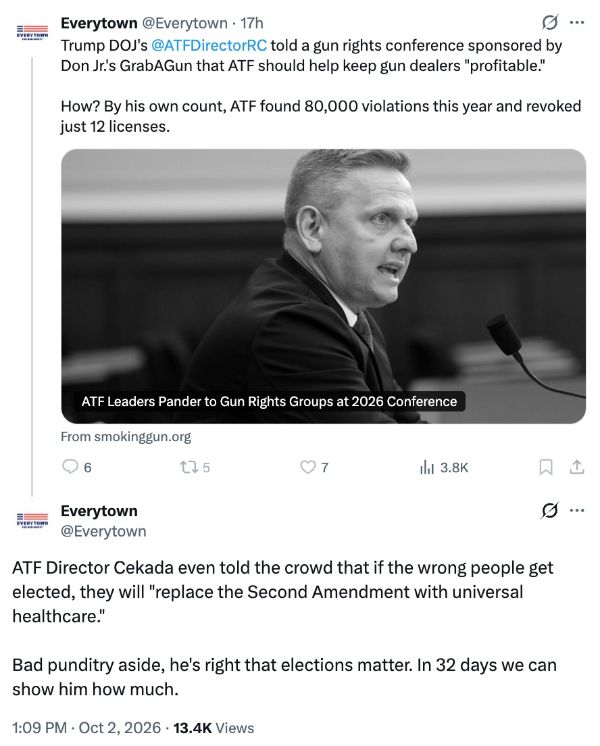
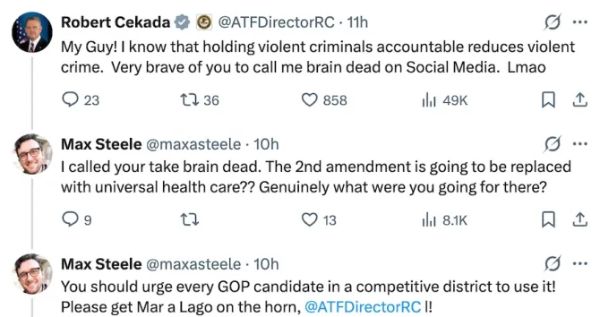
It all started with this. Nothing really unusual here, just Daddy Bloombucks’ Everytown doing what they’re paid to do…attempting to stir up their low-information, red-shirted, wine-swilling membership in the run-up to the midterms. The goal is to elect more “gun sense” candidates that will be reliable automatons, voting to restrict your gun rights and outlaw America’s most popular firearms.

Because “gun safety.” Or something. Just another day ending in ‘y.’

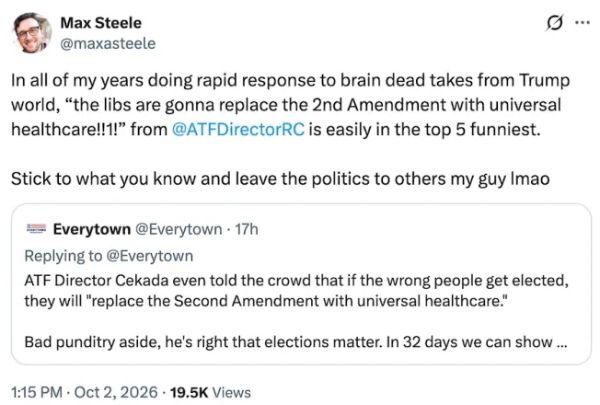
Anyway, that’s when Evertown’s chief flack — Max Steele, their Senior Director of Communications, who probably wrote the initial tweets anyway — added his two cents from his personal account, amplifying what he’d already said.

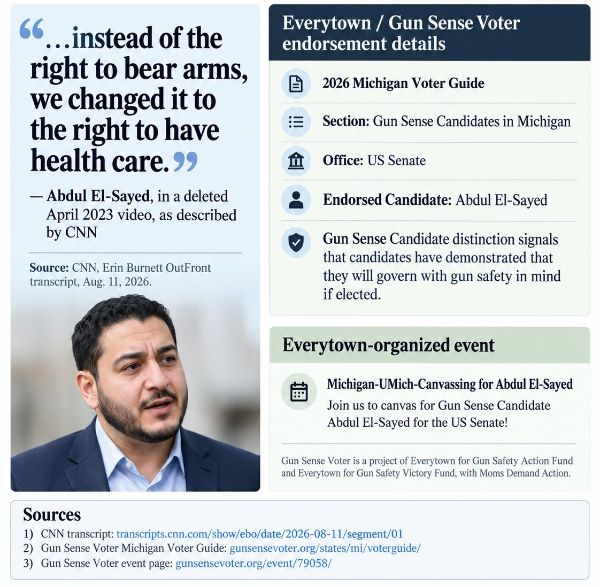
If you’re wondering, Cekada was probably talking about Democrat campaign talking points like this . . .

And who should enter the chat at that point? Why, none other than ATF Director Robert Cekada himself, objectively the most gun rights-friendly head of the firearms regulatory agency we’ve ever seen.

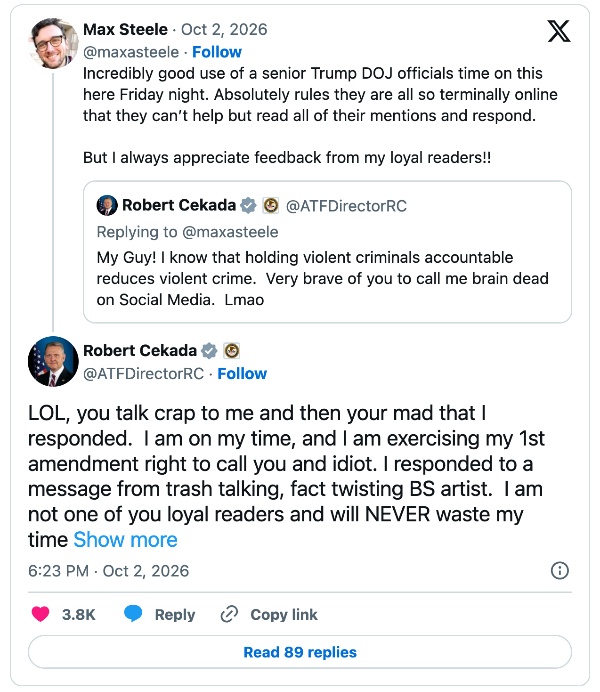
Steele, being the a smug, bottom-feeder he is, clearly never expected Cekada to take exception to his trolling, let alone crack back at him publicly. All Steele could think of at that point was to criticize Cekada for…responding to his sh*tposting.

That prompted Cekada to come right back at him from the top rope . . .

Look, we know lots of you don’t believe ATF should exist at all, but how can you possibly be blackpilling when the man who runs the federal firearms regulatory agency kicks back with an adult beverage on a Friday evening and takes time to bang out a few tweets slamming one of Michael Bloomberg’s paid mouthpieces and calling him an idiot?

– Dan Zimmerman

- CALENDAR OF EVENTS -
September 30 - October 4, 2026

Coalinga Rifle Club in Coalinga, California

October 9-11, 2026
Bassmaster Collegiate College Cup

Wilson Lake, Florence, Alabama

October 12, 2026
Columbus Day
 

October 13-16, 2026

Phoenix Convention Center, Phoenix, Arizona

 
Outdoor Wire - 155 Litchfield Rd., Edgartown, MA 02539
Copyright © 2026, OWDN, All Rights Reserved.