
Frank Sargeant
Frankmako1@gmail.com
It’s perhaps telling that the USA, which has some of the best shark protection on the planet, also has the highest number of sharks biting humans—but the numbers are still very low, just 36 overall on both coasts.
According to the Florida Museum of Natural History, which keeps the official shark bite records, Florida is again tops in this unfortunate statistic, with 16 unprovoked bites last year. According to the study, the total for 2023 is lower than Florida's recent five-year annual average of 19.
Florida gets relatively more bites because it has a whole lot of people using its beaches for at least 8 months a year, and also because it has a huge shark migration along its east coast. The sharks follow vast baitfish schools south in October, back north in March/April, and aerial photos sometimes show literally hundreds of them close to popular beaches.
The wonder is not that a few people are bitten, but rather that a whole lot more are not.
You can pretty well bet, if you swim more than chest deep during the prime months, that there are sharks within a hundred yards of you in hotspots like Volusia County. Surfers are among those bitten most often proportionately to their numbers, perhaps because they frequently paddle out well offshore, and because they make an easy target floating at the surface. Still, even among surfers, bites are so rare as to be almost non-existent.
Volusia County Records Most Shark Bites
Volusia County has the most bites overall in the state, with 351 total from 1882 until now. Half of the bites in Florida from 2023 occurred in Volusia County—the Daytona Beach/New Smyrna area.
There were reportedly 69 total unprovoked bites worldwide, a remarkably low number when you think about the millions of people who swim in coastal waters everywhere. (Odds are good that there are a number of unreported bites from undeveloped countries, but still it’s clear that the overall total is low.)
Bottom line is that sharks just don’t go around looking for humans to chomp—you have to be incredibly unlucky or foolish to get bitten.
Not to say it does not happen and that some of the bites are not devastating—or fatal. In 2006 a St. Pete resident jumped off his dock into a Tampa Bay bayou and was immediately struck by a large bull shark. He died within minutes. Tens of thousands of others do the same thing every summer all along the Gulf Coast without issue, even though shark numbers are steadily increasing throughout this area.
Luckily, there were very few fatal bites last year and only two in the U.S.—one in Hawaii and one in California. Around the world, there were 10 fatal attacks, with four in Australia, the country sitting just behind the U.S. in total number of unprovoked attacks with 15. The others occurred in Egypt, the Bahamas and Mexico.
For those considering an alternative to vacationing in Florida due to the attacks, unfortunately, the state in the second spot is also another vacation hot spot: Hawaii. The state saw eight unprovoked attacks in 2023.
Avoiding shark bites
The obvious way to avoid shark bites is never to swim or wade in coastal waters more than knee deep. But for those of us who spend a lot of time chasing fish, surfing, diving or just enjoying saltwater, there are other cautions that have a very high likelihood of keeping you safe from encounters with a 2024 version of Jaws.
First is to only swim in clear, calm water where visibility is good. Sharks don’t often approach a human on purpose.
Second is to stay out of the water if there are a lot of baitfish present—bait attracts sharks. Ditto regarding fish cleaning tables in harbors—a young angler was bitten just last month when he fell into marina waters in the Bahamas.
Third is to avoid swimming at dawn and dusk as well as at night, times when sharks most often hunt actively, and when low visibility makes an “accidental” bite more likely.
Fourth is to avoid beaches where big eaters are known to be present—the abundant great whites of Australia’s New South Wales or the tiger sharks that run the outside the reefs on some Hawaiian islands, for example. In more recent years, the waters around Cape Cod have become somewhat dangerous as white sharks make a comeback and are attracted to the area by a restored population of seals.
Fifth is to avoid known concentration areas for sharks—the above-mentioned Florida baitfish migration on the East Coast is a case in point.
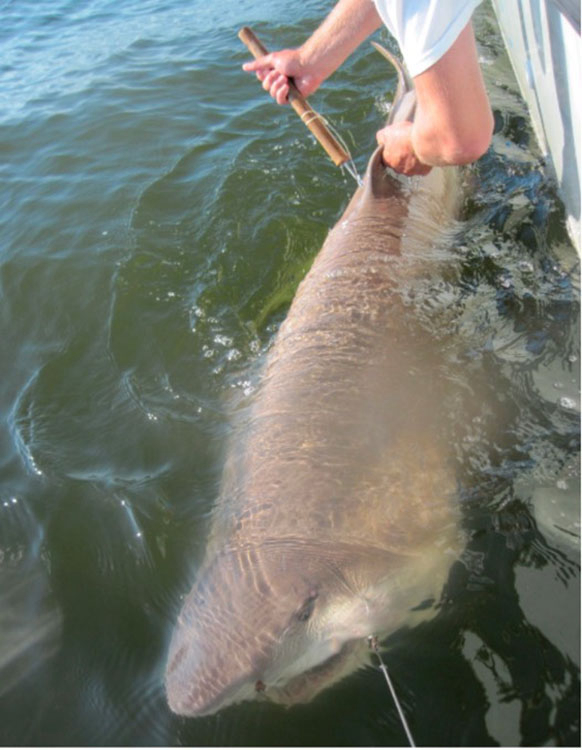
Last but not least, if you decide to go shark fishing for the first time, take a tip from experienced shark anglers—don’t ever put your hands close to the bitey end, even on a shark that seems completely worn out. They bite defensively even when out of the water at times, and even a “little” 3-footer can mean a whole lot of stitches if you’re not careful.
The Florida Museum report can be viewed here.