
 |
McGREW, NE – Wildlife managers in the Nebraska Panhandle say the full effects of the region’s wildfires during the final days of August largely will be determined by what Mother Nature does in coming weeks and months.
The public land most affected was Williams Gap Wildlife Management Area in Banner County. Along with 2,900 acres of adjacent private land, the fire burned about 1,100 acres on the 1,829-acre wildlife area. During the same period, some U.S. Forest Service property 3 miles south of Chadron was burned in the 400-acre Aristocrat Fire.
Acquired by Nebraska Game and Parks Commission, and opened in 2015, Williams Gap features the steep sandstone cliffs of Sheep Mountain and other landforms, making it popular with bighorn sheep. The fire burned many of the trees on the property. How many will survive will not be known until later, said wildlife biologist Chris Becker of Scottsbluff.
Biologists say the amount of precipitation in coming weeks will affect how wildlife populations respond to burn areas this year.
“Overall wildfires have both good and bad long-term effects and how much of each will depend on when we start getting rain,” Becker said of the Hubbard’s Gap fire. “It will likely make the area better bighorn sheep habitat with the reduction of woody vegetation.”
However, it could have negative effects on deer and turkey hunting this year if there is not much green-up, he added.
“Much of the upland bird-small game habitat was burned and won’t provide much hunting opportunity this season,” he said.
Rick Arnold, a biologist based at Ponderosa Field Office near Crawford, responded to both fires and observed wildlife as they escaped the scene. A ewe and a lamb bighorn sheep were found dead after the Hubbard’s Gap burn, but no other significant wildlife losses were observed.
“We saw some really nice mule deer bucks in that rough country behind the college on Forest Service,” Arnold said, in reference to the fire near Chadron. “With any rain, those deer will be right back on the fall green-up forages.”
Wildlife biologist Justin Powell of Alliance said fire is not all bad. He said some animals may be driven off the burned areas, but some may be attracted to it.
“The Aristocrat fire was a pretty beneficial burn. Besides losing some of the regeneration trees, it did a great job of cleaning up old deadfall from the ’06 fire in the same location,” he said. “In general, fires can be super beneficial to a hunter. In fact, in states like Colorado, a good way to find elk is to target burn areas. No exception here —fresh green vegetation, less cover for predators, and easily available grit and insects — all a draw for game animals.”
More than a half-dozen Game and Parks employees joined the many volunteer fire departments and other responders on the fires. In addition to loss of trees, boundary fence posts and signs at Williams Gap will need to be replaced.
Even though it has been dry this summer, Becker said the fuels at Williams Gap had been reduced by grazing cattle and was somewhat surprised the fire was able to move over the property as quickly as it did. The tenants moved cattle from the property just before the fire arrived.
Wildfires have raged throughout the western United States this summer. Nebraska officials are hopeful that no catastrophic wildfires start this fall, but with much of the region suffering from a drought the risk still remains high. They encourage people to use extreme caution with outdoor activities.
While lightning has been identified as the cause of the fire near Chadron, officials suspect human activity may be to blame for the Hubbard’s Gap fire. It is still under investigation.
-30-
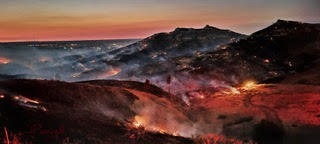
Photo 1 of 5: The glowing flames of the Aristocrat Fire join the lights of Chadron in the distance. The fire burned many of the fallen pines that were scorched during the 2006 Spotted Tail Fire – a much larger blaze that burned to the edge of the city. (Photo by Justin Powell)
Photo 2 of 5: A mule deer doe and two fawns stand in the distance as the fire burns in the Wildcat Hills. (Photo by Justin Powell)
Photo 3 of 5: The sun shines through the smoke during the Hubbard’s Gap Fire in the Wildcat Hills near McGrew. The steep terrain makes the area prime habitat for bighorn sheep. (Photo by Justin Powell)
Game and Parks grateful for firefighting partners
ALLIANCE, Neb. – The Nebraska Game and Parks Commission credits the outstanding work of volunteer fire departments and other responders in limiting damage from two Panhandle wildfires in late August.
The Hubbard’s Gap Fire in the Wildcat Hills south of McGrew burned about 4,000 acres, including more than 60 percent of the land at the 1,829-acre William’s Gap Wildlife Management Area. During the same period, the Aristocrat Fire burned about 400 acres in the Pine Ridge 3 miles south of Chadron.
Along with air tankers, helicopters and dozens of responders on the ground, more than a half-dozen Game and Parks employees sprang into action with their wildland firefighting rigs, known at Type 6 engines, and other equipment.
Wildlife manager Matt Steffl of Chadron said a strong working relationship with local volunteer fire departments, the U.S. Forest Service and the Nebraska Forest Service was key.
“Our staff training on fire behavior and prescribed fire techniques, along with wildfire courses and past practical experience, all played into this,” Steffl said. “The equipment that we use for land management, including burn units and hand tools, was ready and immediately put to use. We also have several agency personnel who have the coursework, practical experience, and certification to work directly with U.S. Forest Service crews on federal properties.”
Steffl said experience from the Pine Ridge’s catastrophic wildfires of 2012 helped ensure preparation this time around.
“After the 2012 fires, we used funds from NGPC, Nebraska Big Game Society, National Wild Turkey Federation and Nebraska Environmental Trust to purchase and furnish a wildfire response trailer with two skid units, drip torches, hand tools, and other equipment,” Steffl said. “One of the skid units along with hand tools was deployed for the Chadron fire. Basically, this is a quick way of turning a standard pickup into an impromptu grass rig for wildfire or prescribed fire.”
Wildlife biologist Justin Powell of Alliance also was thankful the Game and Parks personnel and equipment could contribute to the effort.
“We had to draft out of stock tanks a lot throughout the first night of the Hubbard’s Gap fire,” he said, in reference to the process used to draw water from a static water source. “There was a point where a fire engine wasn’t able to draft correctly, so we ended up drafting from ours and using our hose to fill them up. It felt good to know that a wildlife rig was able to help fellow firefighters continue to do their job.”
Powell also said education and experience was critical.
“Education on fire behavior was big on this for me,” he said. “Between the Wildland Fire Academy, Chadron State College classes and job experience, I felt comfortable fighting some intense fires. There were a couple of head and flank fires that we attacked, and knowing safe approaches and how to attack was key, especially in the middle of the darkness of the night.”
With much of the Panhandle in extreme fire danger, officials are urging the public to avoid any activity that might ignite a wildfire.
|