
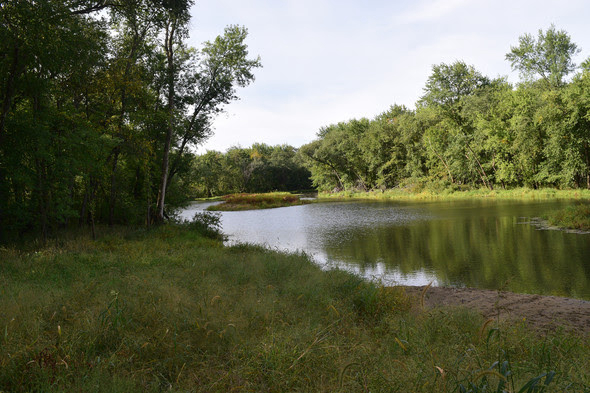
 Restored oxbow of the Wapsipinicon River. Photo courtesy of the Iowa DNR. 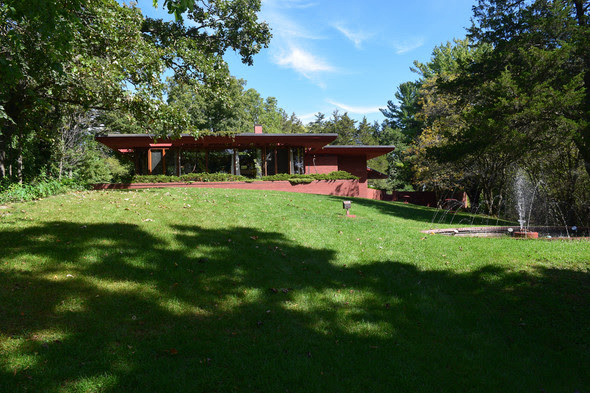 The Walter House, designed by Frank Lloyed Wright. Photo courtesy of the Iowa DNR. |
Staff with the Iowa Department of Natural Resources (DNR) Cedar Wapsi Wildlife Unit were working to install wetlands on the Cedar Rock Wildlife Area when the opportunity to restore an oxbow on the Wapsipinicon River came along.
“There are not a lot of oxbow ecosystems out there and they are difficult to restore,” said Jason Auel, wildlife biologist with the Iowa DNR. “This would not have been possible without federal partnership and federal funding – it was not a cheap restoration.”
The oxbow restoration was selected as a flood mitigation project by the Upper Wapsi River Watershed Management Authority. It identified a six-acre oxbow filled in by five feet of siltation to be excavated to its original riverbed. It would be connected to the Wapsipinicon River on the south end.
Contractors worked during the winter and eventually removed roughly 26,000 cubic yards of silt. That material would be used by Buchanan County for fill as part of its Quasqueton Diagonal road expansion project and incorporated back to Cedar Rock Wildlife Area as part of the restored prairie.
As soon as the oxbow was holding water, the wetland plants returned – arrowhead, bidens, smartweed, cattails. The improved habitat is benefitting ducks, geese, turtles, frogs and more. All that remains for the project is for the last of the excavated silt material to be removed for the highway project and the disturbed area seeded to prairie.
Away from the river, the management plan includes restoring prairie on the old crop fields and then eventually creating an oak savanna using seedlings from the State Forest Nursery. The young oaks were planted in the prairie, then caged to give the young trees a head start. Once the trees are established, the cages will be removed to let Mother Nature take its course.
Auel said the next step is to create a forest management plan to address the tree community on the wildlife area and the adjacent state park.
“It’s a fairly well used public hunting for deer and turkey,” he said.
The maintained firebreaks cover around 2.5 miles and are popular places to take a walk along the prairie and through the timber.
The 153-acre Cedar Rock Wildlife Area is near Cedar Rock State Park, which is home to the Walter House, a home designed by noted architect Frank Lloyd Wright and gifted to the Iowa Conservation Commission in 1981 by Lowell and Agnes Walter.
Media Contact: Jason Auel, Wildlife Biologist, Iowa Department of Natural Resources, 319-213-2815.
Quasqueton-native Lowell and Agnes Walter wanted to build a house for their retirement overlooking the Wapsipinicon River, near his hometown. The Des Moines couple owned Iowa Road Building Company in Des Moines and a farm management business in Buchanan County that amassed around 5,000 acres.
They sent a letter to noted architect Frank Lloyd Wright asking him to design their retirement house and he accepted. The Walters followed up with a topography map and photos of the site that Wright used to design their home. Construction began in 1948 and was completed in 1950.
Wright built 530 structures and designed twice that many, said Katie Hund, park manager for the Iowa DNR at Cedar Rock State Park. There are 10 in Iowa, and three open to the public. The house was donated to the Iowa Conservation Commission in 1981. It was added to the National Register of Historic Places in the 1980s.
The structure was built out of brick, glass and concrete and like many Frank Lloyd Wright structures, it was built without an attic or a basement. Students studying landscape and interior design from Iowa State University, Kirkwood Community College and a college in Wisconsin use the house for education purposes. It’s also popular with art and design enthusiasts who visit the park to experience the architecture, landscape and design of the site.
“The property was a tourist destination when they began construction and the Walters wanted it to stay open to the public,” Hund said. Tours are available from May to the middle of October, Wednesdays through Sundays. There is no fee for the tour. Donations go to the Friends of Cedar Rock.
Hund said more than 10,000 people tour the home each year, coming from as far away as Germany, Japan, and all of Asia.
“The Walters had a strong connection to nature and rural Iowa, gifting their property created a legacy for the public to hunt, fish, recreate and enrich their lives with meaningful architecture and design,” she said.
Media Contact: Kathryn Hund, Park Manager, Cedar Rock State Park, Iowa Department of Natural Resources, 319-934-3572.