
Securing hunting access in Montana is no easy feat these days. But it's hard to imagine just how much more difficult it would be if the Block Management Program didn't exist. From its formalization in 1996, the program has grown to include partnerships between Montana Fish, Wildlife & Parks and 1,326 cooperators across the state, opening public hunting access to nearly 6.9 million acres of private and public land.
"Many cooperators were in access agreements with FWP prior to the 1996 hunting season, but it was through the 1995 Legislative Session where the agency was granted the authority to compensate for hunter impacts as the result of allowing public hunting access," said FWP Landowner Sportsmen Coordinator Jason Kool. "It is the 1996 season we consider the first formal year of the Block Management Program as we know it today."
So on this 30th anniversary year, FWP is celebrating 315 landowners across the state who have been working with the agency to provide access for at least three decades, as well as many others who make the program successful. This week Kool traveled to one of several Cooperator Appreciation Dinners that FWP hosts for families enrolled in Block Management. It is one small way the agency can thank these partners for their role in a program whose benefits go far beyond access.
"I believe the program has helped foster a successful collaboration between landowners and hunters and assisted greatly with contributing to the health of the wildlife resource, health of local economies and positive hunting traditions of Montana," Kool said.
FWP Director Christy Clark attended the Cooperator Appreciation Dinner in Miles City on Feb. 24 at the Town & Country Club.
"Ranching is just such an important part of the community and such an important part of the economy for Montana, and I cannot tell you enough how important you guys are to the hunting heritage. This is what makes Montana, Montana," Clark said.
In southeast Montana, more than 75 percent of the land is under private ownership, so Block Management is a vital tool for hunters to gain access and for landowners to manage impacts.
"For Region 7 alone, we had 85 cooperators reach the 30-year enrollment mark during the 2025 hunting season," regional access manager Travis Muscha shared. "To have that many cooperators enrolled in a program for that many years is truly remarkable. It is a testament to their willingness to help conserve Montana's hunting heritage, to the long-lasting relationships built between the landowners and regional staff, and the many relationships and friendships that have been built between the cooperators and hunters over the past 30-plus years."
"The best part of my job has been working with these cooperators for the past 15 years, and I look forward to hopefully being able to do that for many years to come," Muscha said.
Beyond the 315 cooperators reaching the 30-year mark, there are more than 60 landowners who have been enrolled for 25 years, 35-plus for 20 years, 30-plus for 15 years and 40-plus for 10 years.
Kool said, "We are fortunate to have so many private landowners who desire to do what's best for the land and the wildlife resource and are willing to place their trust in FWP. We recognize it's not possible to have a program without willing landowners, hunters willing to purchase licenses and assist with offsetting some of the impacts, and FWP staff to building lasting local relationships."
He added, "We must also give a nod to the many private landowners across Montana who provide public access with no formal involvement in an agency program. They greatly deserve credit as well."
At cooperator appreciation dinners, businesses and sportsmen's groups around the state donate hundreds of door prizes to recognize landowners' contributions. In FWP Region 7, the Hunters for Access group gathers many of those donations, and the sportsmen volunteer their time to help landowners with fencing and other projects.
What makes landowners stay in Block Management?
When it comes to 30-year cooperators, it's not uncommon for FWP to work with multiple generations of a family.
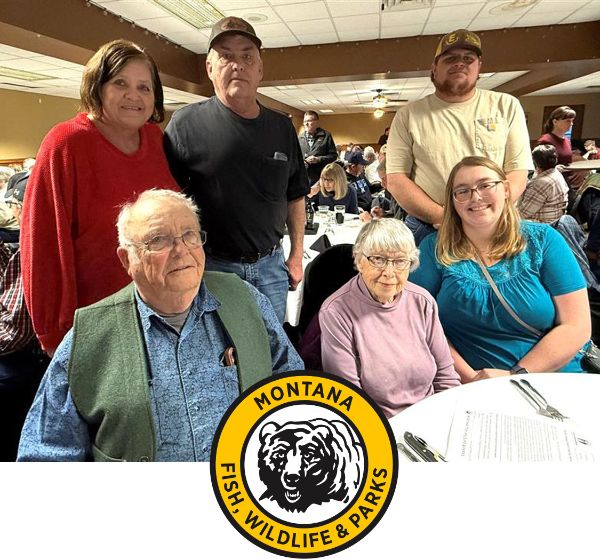
The Pfaffinger Ranch in Treasure County was founded by Jessee Smith in 1904. Jessee's granddaughter, Shirley Pfaffinger, and her husband, Swede, attended the Miles City dinner, representing five generations on the ranch. They were joined by their son, Trent Pfaffinger, and his wife, Elida; and their granddaughter, Lauryn Dannon, and her husband, Rami.
Swede saw Block Management as a way to counter frequent poaching on the ranch.
"The big thing that appealed to me in the beginning was assistance from game wardens," Swede said.
He recalls three game wardens writing 73 tickets on a 15-mile stretch of road in one year.
"We've had that kind of assistance ever since," he said. "It's just been fantastic."
Swede sees many benefits, but the best for him has been the friendships the family has built.
"Block Management has offered me the opportunity to meet bunches of people who've become very good friends," he said.
It's not uncommon for his longtime hunters to help other hunters newer to the property.
"To see that camaraderie and friendship built, I think it's a neat thing, and a great method of keeping the hunting tradition alive, especially with young people," Swede said.
Rocker Six Cattle Co., owned by Clint McRae, is a cow-calf operation about 15 miles south of Colstrip. The ranch was started by Clint's great-grandfather, John B. McRae, who emigrated from Scotland in the mid-1880s and settled on Rosebud Creek. Clint is the fourth generation, and soon his daughter, Elizabeth Stevenson, and her husband, Brenden, will be taking over the reins. Their two young sons will be the sixth generation.
Development of the Colstrip power plant in the mid-1970s and early '80s influenced the family's decision to enter into Block Management
"We saw a big influx of people when the Colstrip power plant was being built, and we noticed an increase in people wanting to hunt," McRae said. "We had lines of cars out front, and we were doing it by permission only, so something had to give."
A biologist convinced them to try Block Management, and they've been in it ever since.
"We feel an obligation to share our ground with other people," McRae said. "We fully understand that the public owns the wildlife, and as long as people appreciate it and toe the line, we're more than happy to share it with the public. We figured it was the right thing to do."
"The easiest thing to do would have been to hire an outfitter, from a ranch management standpoint," he added. "We're probably fools because it's a lot more income, but that's not the reason why we do it."
Two wildfires years apart reinforced McRae's desire to give back. In both 2012 and 2021, fires claimed large stretches of fence on the ranch. In each case, sportsmen from across the state, conservation groups and agencies pitched in for supplies and gathered work crews to replace fences.
"I didn't even know some of these people," he said. "They didn't have to take their time to come and fix fence. That's why I do it -- I just appreciate that there would be that much help from people."
Brian and Maggie Dice saw Block Management as a way to continue allowing public hunting on their ranch and still run it the way they wanted to.
"We're going to allow hunters anyway, so basically we have the same hunters, and we're getting paid an impact statement, but it's not changing our operation any to be in it," Brian said.
The Wegner and Dice Ranch is about 15 miles south of Volborg.
"We've had hunters coming here for years, and we've made some good relationships," Brian said. "We've never gotten into an issue, and if we did, we'd have backup."
Scot Brown doesn't run cattle anymore on the ranch his dad, Bob Brown, started in the 1940s near Circle. Where there were cattle, there's now CRP grass and trees. But he has kept up the tradition of welcoming hunters.
"We never had any problems in the program, and the main reason we started never changed: We liked to hunt, and we liked hunters," Scot said. "And the extra Christmas money was always nice, too."
"It's been a good program," he said. "I've always supported it."