
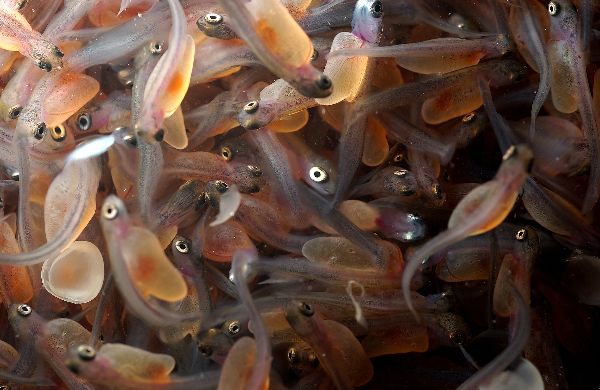
After a lightning strike at the Little Manistee River Weir (Manistee County) threatened to derail steelhead egg collection for this season, the Department of Natural Resources rallied to collect approximately 4.2 million steelhead eggs for Michigan's state fish hatcheries. Staff were able to proceed with collection at the Little Manistee Weir, as well as deploy the Lower Platte River Weir (Benzie County) as a backup egg source for the first time, both of which contributed to the successful collection of steelhead eggs for future stocking throughout the state.
During severe weather the night of April 13, the Little Manistee River Weir facility was struck by lightning, which took out the main power, backup power source and emergency alarm notification system at the facility. This resulted in a loss of some of the fish being held in maturation ponds, as the systems that sustained the fish were offline — egg collection was scheduled to begin the following morning.
Once the damage was discovered, staff worked swiftly to restore power to the facility and collect eggs from the live fish on-site. Egg collection proceeded at this location in the following weeks, with the final collection there occurring April 29.
The DNR quickly identified the weirs at Platte River State Fish Hatchery as the best available backup source for steelhead eggs. The Lower Platte River Weir was deployed April 17 to block further upstream migration of steelhead and eventually divert them to a holding pond for collection. The fish were trucked from the lower weir to the maturation ponds at the Platte River State Fish Hatchery, where steelhead egg-take operations began May 5 and wrapped up May 7.
Michigan's projected steelhead egg needs were met during the collection efforts this season. Of the 4.2 million steelhead eggs collected, nearly 2.2 million were collected at the Little Manistee River Weir and approximately 2 million were collected at the Platte River weirs. This is just short of the original goal of 4.6 million eggs, some of which would have been provided to Ohio and Indiana for their stocking programs. These states were able to receive eggs from another source.
Until now, the Little Manistee River Weir served as the state's only egg-collection facility for steelhead, making it vulnerable to rare, unpredictable occurrences — like the lightning strike — that could render the facility inoperable. Equipment that was damaged due to the storm is being repaired and replaced as appropriate, and the DNR is pursuing an improved alarm system for the facility. Despite the unfortunate loss of fish, fisheries managers do not expect any lasting negative impacts to the fishery.
While the Lower and Upper Platte River weirs were a valuable backup source for steelhead eggs, providing nearly half of the total collected this year, the weirs were not set up for this purpose. These weirs are typically used for coho salmon egg collection, during which fish are harvested, as it is the end of their life cycle. Steelhead, however, can spawn multiple times in their lives and are returned alive to the river after gametes (eggs and milt) are collected. Extensive modifications to the Platte River facilities to allow fish to be returned to the river would be necessary for the location to serve as a steelhead egg-collection site in future.
"We made it happen, but there was a significant reallocation of staff time, overtime hours and modifications to typical egg-collection operations," said Joe Mickevich, southern area hatchery manager for the DNR. "As a result, and with staffing levels at a bare minimum, we are still working to complete the fish stocking and survey work that was affected and is dependent on weather and water conditions."
This season's severe weather presented additional challenges during this high-activity time, not only due to the need to triage steelhead egg collection, but also because staff were monitoring high water levels and department-owned dams.
"This spring season has been full of challenges for the Fisheries Division," said Randy Claramunt, chief of the DNR's Fisheries Division. "But we rose to those challenges. Our staff's teamwork, resilience and focus allowed us to adapt to the changing situation and continue to meet our mission to manage the fishery for public benefit."
Learn more about how the DNR manages Michigan's trout and salmon.