
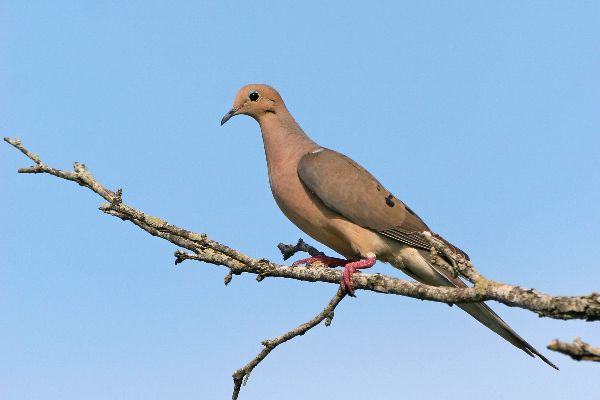
SALT LAKE CITY — If you are wanting to try hunting for the first time or if you are a seasoned hunter looking for a new opportunity, upland game hunting is a great option! The majority of the upland game hunts in Utah are open to anyone with a Utah hunting license and don't require an additional permit.
Utah offers a variety of upland game species, including:
- Two species of doves
- Band-tailed pigeons
- Five different species of grouse
- Two species of partridge
- Cottontail rabbits
- Snowshoe hares
The Utah Upland Game Management Plan was approved in 2022 to guide the management of upland game species in the state through 2032, and includes helpful resources including distribution maps for hunters.
Whether it's a long-standing family tradition or you just want to try a new hunting opportunity, here is a look at how Utah's upland game populations are currently doing along with some tips that will help you during the hunts this fall.
Doves (mourning and white-winged)
Dove numbers should be similar or slightly above last year in much of Utah this year.
"Mourning doves can often be found near agricultural grain fields, especially those with wheat and safflower, as well as areas with sunflowers because they provide a good food source for the birds," Utah Division of Wildlife Resources Upland Game Coordinator Heather Talley said. "Doves also need lots of water throughout the day, so hunting over water sources (including springs in sagebrush rangelands) and near feeding and roosting sites can help hunters find more doves."
If you want to hunt on private land, like on an agricultural field, you must obtain documented permission from the landowner in advance.
White-winged doves are more rare in Utah, but can occasionally be found in the southwestern areas of the state. Hunters should also keep an eye out for white-winged doves in the same areas as mourning doves. Hunters may also see collared-doves during their hunt. Collared-doves are not protected in Utah and can be hunted year-round without a license or a bag limit. Collared-doves can also be found near agricultural areas.
"The weather in late August and early September can affect how many birds will be seen during the hunt," Talley said. "Doves tend to begin migrating south when nighttime temperatures drop into the 50s and as days get shorter, so hunters should plan to target them earlier in the season to increase their chances of success."
Because mourning and white-winged doves are migratory birds protected by federal law, you need a Harvest Information Program number to hunt them. Getting a HIP number is easy and only takes a few minutes. You can register for a free HIP number on the DWR website.
The hunting season for mourning and white-winged doves begins Sept. 1 and runs until Oct. 30. For more tips on hunting doves, visit the DWR website.
Band-tailed pigeons
While DWR biologists don't do formal surveys for pigeons in Utah, the population has been relatively stable in recent years.
Look for band-tailed pigeons in southern Utah in areas with Gambel oak, aspen and conifers. Due to recent precipitation patterns, Gambel oak acorn production has likely declined in many parts of the state, which is typically what pigeons rely on for food in the fall.
"Many Utah hunters don't take the time to hunt band-tailed pigeons because they are a fairly secretive bird that is difficult to find," Talley said. "However, they can be a unique challenge and an interesting new opportunity for hunters who are willing to put the time in to find them."
Hunters should note that collared-doves and band-tailed pigeons are often mistaken for one another. Collared-doves are primarily located in agricultural areas, while band-tailed pigeons are typically found in forested areas. Review the 2026-27 Waterfowl, Upland Game and Turkey Guidebook for more details.
Hunting band-tailed pigeons does require a permit, but the permit is free and available on the DWR website. You also need a HIP number to hunt band-tailed pigeons. You can register for a free HIP number on the DWR website.
The pigeon hunting season runs from Sept. 1-14.
Grouse (dusky and ruffed)
There are several grouse species throughout Utah:
- Dusky grouse (also known as the blue grouse, pine hen, pine grouse and fool hen)
- Ruffed grouse (also known as forest grouse and willow grouse)
- Greater sage-grouse
- Sharp-tailed grouse
- White-tailed ptarmigan
Due to a decline in precipitation throughout the state last winter and spring, this year's grouse reproduction has experienced overall declines.
To hunt either greater sage-grouse or sharp-tailed grouse, you need a special permit in addition to a hunting license, and the application period for those permits ended July 14. White-tailed ptarmigan also require an additional permit, which is available on the DWR website. However, you can still hunt dusky and ruffed grouse this fall with just a hunting or combination license.
"For anyone hunting sharp-tailed grouse, we are asking for voluntary wing samples," Talley said. "The information for participating was included with all mailed permits. These samples will help us conduct important genetic analysis."
Dusky grouse are about the size of a chicken and have drab brown and gray coloring. Their tail feathers are black except for the tips, which have a lighter gray color, and look like a wide band when the tail is fanned.
Ruffed grouse are gray and red and have a group of black feathers on the sides of their neck. Their tail feathers are the same color as their body, but have a dark black band near the end. Ruffed grouse can be found in stands of aspen, particularly young aspen. The aspen stands that also have shrubs with berries and a water source are the best places to spot a ruffed grouse. Hunters can also find ruffed grouse in mahogany patches.
For more tips on distinguishing between the different grouse species, visit the DWR website.
During fall and winter, grouse forage on the ground in areas where flowering plants (such as elderberry or serviceberry) or grains are available, and in areas dominated by thick sagebrush or in trees or shrubs with fruits and buds. Keep in mind that dusky grouse eat pine needles in the winter, and ruffed grouse eat buds from aspen trees. Hunting in areas with these food sources should bolster success later in the season.
"Hunters should locate berries for areas with good concentrations of forest grouse earlier in the year, but keep in mind that they will transition to aspen or pine needles later in the year," Talley said. "Dusky grouse migrate upslope as the season progresses and can be found in high-elevation conifer forest areas by early October, while ruffed grouse will be found in aspen, with thick tree and shrub cover; they don't make large movements like dusky grouse do."
If you're able to hunt with a dog, the best time to hunt grouse is an hour or two after sunrise, while the birds have been feeding, so their scent is on the ground for your dog to track. If you hunt grouse without a dog, try early in the morning or late in the afternoon since that is when the birds are actively feeding and will be the most visible.
"People usually hunt grouse with dogs, but you will still want to move slowly and stop routinely to listen for birds. You may even be able to see them ducking behind brush as you pass," Talley said. "Sporadically stopping may cause the grouse to get nervous and flush if you are close enough to them. And when they flush, they will be gone in an instant, so be ready to shoulder your gun for a shot. Since grouse spend most of the day on the ground, you can still find them at any time during the day. This means you can still be successful if you are hunting without a dog during prime feeding times."
Hunters should look for ptarmigan in areas with green, succulent vegetation near water sources and in high-elevation willow patches, especially at the base of rocky slopes. Keep in mind that mountain willows are short like bushes, and don't resemble willows found in riparian areas in valleys.
The dusky and ruffed grouse season runs from Sept. 1 to Dec. 31, and the ptarmigan season runs from Sept. 1 to Oct. 31.
Partridge (chukar and gray)
Chukar numbers should be average or slightly increased in some areas of Utah this year, with some declines in southern and southeastern Utah, due to drought conditions. Hunters should also note that, as of 2025, the DWR no longer releases pen-reared chukars on public lands, due to budget constraints.
Hunters should focus on steep slopes with rocks and bunchgrass, sagebrush or cheatgrass, as well as areas with water. The best time to hunt chukars is early in the morning because that's when they feed and tend to be vocal, making them the easiest to find.
"If one of the birds spots you while the rest are feeding, it will call out to alert the others, helping you locate the rest of the group," Talley said. "You may increase your success rate hunting near water, but chukars aren't completely dependent on water, and rely on it even less as the season progresses. Once winter hits, hunt the south-facing slopes, where the sun will be melting snow and warming the rocks, making the area enticing for chukars."
Grey partridge (also known as Hungarian partridge) are only found in northern Utah. DWR biologists anticipate a decrease in gray partridge numbers this year, due to two consecutive years of limited precipitation, leading to harsher conditions for brood survival.
Both partridge seasons will run from Sept. 26 to Feb. 15, 2027.
Cottontail rabbits
Cottontail rabbit population numbers are increasing in most parts of Utah, and they should be more abundant this year. There are also a few places with populations that have not yet rebounded from overly dry conditions, or from heavy snowfall a few winters ago.
Look for these rabbits in creek bottoms and washes, near thick sagebrush and willow trees. Cottontail rabbits can also be found near rocky outcroppings. Hunters should also try hunting early in the morning or late in the afternoon when the rabbits are feeding.
"Hunters also often have success finding cottontails in the transition areas between sagebrush and agriculture fields," Talley said.
If multiple hunters walk in a straight line with several yards between them, they're likely to find some rabbits feeding or resting. Be sure to walk slowly and quietly because cottontails have incredible hearing. Wearing hunter orange is imperative, since it won't hinder your hunt, and will make it easier for other hunters to spot you.
Small caliber rifles, such as .22 and .17, are great for rabbit hunting, or you can also use shotguns with No. 6 shot (many shotgun boxes display pictures of the targeted species on the box if you want to try different types of ammunition). Note that some areas require lead-free ammunition, so be sure to look up restrictions before you head into the field. Find more cottontail rabbit hunting tips on the DWR website.
Hunters should also note that rabbit hemorrhagic disease was confirmed in several wild rabbit populations in Utah in 2020 and in rabbits in Summit and Tooele counties earlier this year.
"The good news is that, so far, it doesn't look like rabbit hemorrhagic disease resulted in widespread, permanent losses of rabbits in any of these areas," Talley said.
Infected wild rabbits may be lethargic and not flee when approached. If the rabbit you harvested seemed to act normally at the time of the hunt, it is unlikely that it has the disease. However, if you notice any discoloration or excessive bleeding on internal organs after harvesting the rabbit, or if you see anything that appears abnormal or causes concern, please contact your local DWR office and as a safety precaution do not consume the rabbit.
The cottontail rabbit season runs from Sept. 1 to Feb. 28, 2027.
Snowshoe hares
Snowshoe hare populations are currently low statewide. Hares can be found in high-elevation forest areas with conifer and aspen trees. The best habitat for hares is typically 8,000-9,000 feet in elevation and is more difficult to access than where cottontails are found.
While they are a brownish-gray color in the summer, snowshoe hares are completely white in the winter, except for the black tips of their ears.
"The best strategy for finding hares is to wait for the first snowstorms of the year, and then look for the hare's unique tracks," Talley said. "Their track looks like a miniature snowshoe, hence their name. Snowshoes or snowmobiles are often essential if you want to hunt snowshoe hares after winter storms occur."
Snowshoe hares have a limited home range, so if you find an area that has plenty of tracks in it, there's a good chance a hare is hunkered down in some vegetation nearby. Move slowly through their habitat, watching for the outline of a hare and its dark black eyes. Kicking brush piles as you walk can also cause hiding hares to flush into the open.
Small-caliber rifles and shotguns are great firearms to use for hunting hares.
The snowshoe hare season runs from Sept. 1 to March 15, 2027.
Upland Game Slam
To add an extra challenge to your hunts this fall, consider participating in the Upland Game Slam. The slam encourages hunters to harvest a variety of upland game species, while generating money to help fund a variety of habitat and upland game-related projects.
Hunters complete a slam by harvesting the required amount of the target species. There are currently eight different slams that hunters can participate in (one is for youth only). Each slam is designed to give you an extra challenge while you're hunting, as well as the opportunity to earn a commemorative, collectible coin. The entry fee is $20 for hunters 18 years of age or older, or $10 for hunters 17 years of age or younger. Learn more about how to participate in the Upland Game Slam on the DWR website.
Check the 2026-27 Waterfowl, Upland Game and Turkey Guidebook for details on regulations for hunting each species, including the legal weapons for each upland game species.
Youth hunts
The dates for this year's upland game youth hunts are as follows:
- Chukar and gray partridge: Sept. 19–21
- Quail: Oct. 31 to Nov. 2
- Pheasant: Oct. 31 to Nov. 5
The DWR and partners will also be holding several organized youth pheasant hunts in November in different areas of the state. Pheasants are released in areas across the state prior to their respective youth hunting seasons, as well as before the general hunting seasons. Visit the DWR website for more details about those upcoming events and for additional information about quail and pheasant hunting tips for this fall's hunts.